Friday, 14 September 2012

India Sojourn (Day 4) - Jaipur Part 2

It was noon and lunch was calling. We were brought by our guide to a restaurant beside an exotic (aka quaint, homey) hotel. We were greeted by a mustachioed gentleman who was equally exotic looking. The interior of the restaurant was very frugal to say the least. Rickety chairs and threadbare tablecloth was the order of the day. The food though surpassed all expectations. Don't you just love it when that happens?
 
The food we have been partaking so far would fall under the category of Northern Indian cuisine and i think this means it is less spicy and the flavours are less strong. It may also be because we have always been telling them to tone down the heat. Anyway, suffice to say we were always enjoying ourselves at mealtime. Primarily we would be ordering chicken tikka masala, various biryanis (shrimp, lamb, chicken, mutton or vegetables with basmati rice), koftas (fried curried dough with vegetable filling), Palak Paneer (cottage cheese cubes with pureed spinach), and an assortment of Aloo's . We also alternated between the different types of bread offered (Roti, Naan, and Batura) to sop up all the sauces. I was so happy to discover Batura! Talk about mentos (crunchy on the outside and soft and chewy on the inside). This is a deep fried flat bread about 8 inches in diameter and when it gets dunked in boiling in oil the heat puffs it up like a balloon. Are you hungry now? You should be!


Being sated and satisfied with our bellies bursting we decided to proceed to our next stop.
 
Jantar Mantar (I love the sound of that) roughly translates as "instruments of calculation". Don't let that term fool you as the Jantar Mantar is one of the oldest and best preserved astronomical sites in India or the World. Built by the Maharaja of Jaipur in 1734, the site clearly showcases the level of understanding of celestial bodies and how they interact with one another. And it was done in such a grand scale.

There were sundials and sextants with beautiful geometric designs. There was also an astrological aspect to the sites as there are 12 structures that plot the position of each zodiac sign in the heavens.


A stone's throw away from Jantar Mantar is the City Palace.  A portion of the Palace is still occupied by the present Maharaja of Jaipur. As I understand it when Bhawani Singh, the last Maharaja died, he did not have any male heirs to take his place. He decided to adopt his grandson and when he passed in 2011 this grandson then took his place at the age of 13.

This is where he lives.


When were were about to leave the Palace grounds we were able to espy preparations for a grand shindig in a Palace courtyard. Everything matched! From the table cloth, to the napkins, to the wall-to-wall Persian carpets. These guys know how to throw a party!
 
 
 This is a balcony overlooking the courtyard.

 
Other parts of the Palace have been converted into a museum for tourists to wander around.


With that our solitary day in Jaipur comes to a close. The next day brings us a 7 hour road trip to Udaipur. We were supposed to take a plane but one of our companions has this fear of unnecessary flying. So why fly if one can take a 7 hour journey by car? It's all good, our lunch stop the next day is when I discovered Batura!

Also notable to mention is that the temperatures in Jaipur in January can go up to 27C at noon time and dip to 5C at night. That, including the dry dessert air gave me a sore throat.   

India Sojourn (Day 4) - Jaipur Part 1

If you were to spend just a day in Jaipur, the three things you must see are The Amber Fort, Jantar Mantar and The City Palace.
 
Going to breakfast the next morning I took these pictures of the hotel and to me they seemed so old world, like something from the past.


If it is said that It's good to be the King, I suppose it wasn't bad being the Kings personal Physician in them ol' days. (See previous article about the provenance of the hotel)
 
I know I haven't mentioned much about the food we ate but I will, real soon.
 
Jaipur isn't a very big place and because of this the attractions are not too far away from each other. Although commercially it is a very busy place and the roads can get congested at times of the day.
 
 
Popularly known as the Pink City, one travelling the streets would realize that the buildings aren't really pink but a shade of terra cotta. When Prince Edward visited in 1876, the whole city was painted pink to welcome him but recent repainting efforts have decidedly altered the color of the walls. Most Indian cities have adopted different colors to make them distinct from one another. Johdpur is known as the Blue City, Jaisalmer the Yellow City, and Udaipur the Golden City. There is actually a city ordinance that forbids use of other colors of paint in most parts of the area. 
 
On our way to our first stop, the Amber Fort, we passed by the Hawa Mahal or Palace of Breezes. This is situated near the City Palace and was principally used by ladies of the Mughal's Harem and their ladies-in-waiting. Back in the day, they were not allowed out in public and they would peek out these latticed windows to view the goings on in the street or watch a parade go by.


To get to The Amber Fort, also known as the Amer Fort (it is located in the town of Amer), or the Amer Palace, one needs to to get on board an elephant and climb a narrow slope just like the Rajahs did way back when. Our Guide, Naveen (pronounced Naween, Indians seem to have a hard time with the letter "v") told us that the elephants come from a town that is quite a distance away so they knock off at lunchtime everyday so they can make their way back home for some rest and repast.


The abundance of colors that we saw inside the Amber Fort's walls were so different from the previous sites that we saw that were either red or white. 


The three lattice screens you see just below the central roof are where the Queen would observe the goings on in the square below. Imagine, voyeurism was already in practice back then.
 
Below is a photo of the vestibule above the doorway of the building Known as Ganesh Pol of the Gate of Ganesh.
 
The central figure below is of Ganesha, a popular deity with an elephants head and a human torso with multiple arms. Ganesh is known as a remover of obstacles and can be found painted in varying sizes and designs in front of numerous houses. Ganesh was a human prince and how he ended up with an elephants head is an interesting tale.
 
 
In this original ceiling ornament you will still see gold reflect from light coming from the sun.
 
 
One pavilion in the complex that left an imprint in my mind is the Mirror Palace. It has hundreds of thousands of individual mirrors embedded in the walls and ceilings. We were told that the mirrors were all imported by the Maharaja from Belgium.


This platform is where members of the Royal Family would dine and be entertained when the weather permitted. Can you imagine a grand fiesta under a star filled sky!
 
 
And this was their view!
 
 
One thing India has always been associated with is the Kama Sutra (you didn't think I'd never mention it here did you?).  Unfortunately none of the places we went to was even remotely connected with its history. So, when this representation was brought to my attention, I was filled with glee. It was tucked away near the cornice it was so easy to miss.
 
 
I loved the way that the columns and arches were glowing amber in this photo.
 
 
I thought that I could get away with taking a candid picture of this old man in a red turban talking to a soldier. Well, he caught me and here he is asking for money! I of course had to oblige him with a tip...and he goes and asks for more...sheesh...
 
 
So ends part 1...please continue on to India Sojourn (Day 4) - Jaipur Part 2.

Tuesday, 11 September 2012

India Sojourn (Day 3) - Agra, Fatehpur-Sikri, Jaipur Part 2

It took about 40 minutes to get to Fatehpur-Sikri from Agra (I fell asleep for 10 of those minutes). Because red sandstone was plentiful in the area, it was used to construct the different pavilions in the compound. Fatehpur-Sikri is renowned for having one of the best preserved collections of buildings representative of Mughal Architecture. We had to take a mini bus up to the top of a rocky ridge where this ancient city was built. Greeting us were trained craftsmen who were working to restore the site to its original glory. Everything was done by hand just like it was centuries ago.


The DIWAN KHANA-I-AM was where Akbar (Shah Jahan's grandfather) conducted the business of running his empire. As the sign says, this was where he saw to and dispensed his style of justice.  


The stone ring you see on the ground amidst the grass is where a great big elephant was chained to. It was said that those sentenced by Akbar to death was brought here and trampled into the afterlife by that elephant (another one of Deepaks little morsels of history). Of course, among all the information that was fed us, I chose to remember this grisly one.
 
 
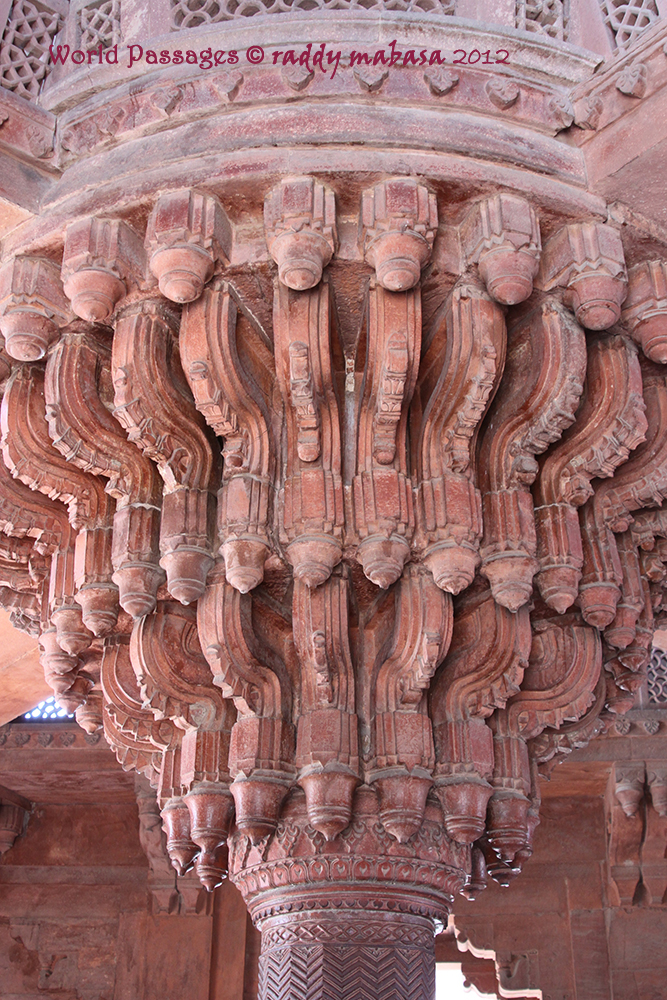
The DIWAN-I-KHAS is known as the Hall of Private Audience and is easily recognised because of this exquisitely central pillar carved from a single block of sandstone. This pillar supported a circular platform where four bridge ways extended out into the outer walls of the building. This is where Akbar would receive representatives of different religions to discuss faith with.


Of all the structures at the site I found the Panch Mahal the most interesting. Pyramidal in shape, the Wind Tower had five open asymmetric levels that started with a wide base and was topped by a large dome at the highest point. These levels were supported by intricately carved columns and may have had carved stone screens in the past for privacy. Being the highest structure on top of a hill allows for a nice breeze. Members of the Mughal's family would hang out here at sundown and enjoy the view and each other's company. Each tier denoted how important you were in the hierarchy. Guess what? The queen got to stay at the topmost level. I suppose whipped rulers were also fairly common in those days.


I apologise as my tired mind could no longer remember what this building is, but I'm sure it belonged to someone important to the Emperor.
 
 
And with that, Deepak, our guide bade us adieu, so long, farewell. We then hurriedly went to find  place to fill our empty stomachs. Jaipur was a long way away and our minds were numbed with fatigue...well, mine was...
 
The road to Jaipur was mostly flat expanse. Once in a while fields filled with yellow mustard flowers would stretch along the side of the highway. It was also of note that there were not many bodies of water along our route. Rivers were as rare as a McDonald's outlet (I only saw 2 in our 7 days in India and they were not even in urban centers).
 
As light began to fade, I could discern a slight change in our car's pitch. We were beginning our ascent and Jaipur was not far ahead. Soon, winding roads emerged and we zigged and zagged onto higher elevations. After hours spent on the road I couldn't wait to get to our hotel, but being deprived of the opportunity to shop in the last 2 days, my travelling companions had other ideas and decided on a detour. Jaipur is known for Pashmina shawls, Persian carpets and Precious stones. 
 
After a few purchases, we were again headed in the right direction towards comfort. At the gate of our hotel, the guards on duty made sure we were who we said we were. Apparently, getting into a hotel in India is akin to entering Fort Knox. Security is very tight, tighter than a gnats a$$ (pardon my French).
 
Because of the higher elevation, it was chilly out (about 5C) and  through my winter clothes, the wind bit into my sensitive dermis. Out hotel used to be a villa that belonged to a former Mughal's personal Physician and it was truly befitting. There was an area off the garden where some entertainment was available nightly. There were dances...
 
 
Puppet shows...


and a nice warm fire...


No, that's not me in the black jacket.
 
After a nice late dinner we could finally feel the day's fatigue settle into our bones. It was time to call it a day.

India Sojourn (Day 3) - Agra, Fatehpur-Sikri, Jaipur Part 1

Sigh. Another early day. I am not a morning person. It helps that there are lulls in between the sight seeing, so I can catch a few zzzzzzz's in the car. Day 3 and I'm already complaining...hahahaha
 
Well, there was one more place to see in Agra before we headed out.  The Agra Fort as you see it now, was rebuilt by Shah Jahan. His grandfather, Akbar, was the first of their line to occupy this fort. Red sandstone was greatly utilised in the re-construction during his reign.
 
It's ironic that in his last few years Shah Jahan was imprisoned in this fort by his son Aurangzeb who accused him of spending too much wealth on his construction projects. He would walk 2.5 kilometers  to the Taj Mahal everyday to visit his wife's resting place. Deepak, our ever informative guide told us a bit of trivia. From Shah Jahans prison tower in the fort, he could see the Taj Mahal and at night the dome would glitter like stars from the large diamonds that were embedded in the white marble.
 
Another claim to fame by the fort is that this is where the famous Koh-i-Noor diamond (a whooping 186 carats) was taken from. This valuable stone has a long and intriguing history, but to cut that long story short, it was taken and is now part of the British Crown Jewels. 
 
I told you Deepak knew his stuff...


These were some of the architecturally interesting points we would see near the entrance. The Agra fort is also a massive complex and there is still a restricted area occupied by the military.
 
 
Being predominantly Hindu, the Indians have such a high regard for life of any form and animals are generally left alone. I found this bird living with its brood in a hole on the wall. Scenes like this are fairly common in this country.
 
 
This is a carved area map of the Agra Fort. Try and look for the building named MACHCHHI BHAWAN (it's in the middle portion and a bit blurry) as we will see more pictures of this in a bit. It's very interesting, I guarantee. Trust me...
 
 
The canopied alcove you see below is the most important part of the DIWAN-I-AAM or the Hall of Public Audiences where the Mughal ruler sits and rules. This is where he usually received foreign dignitaries or ruled on disputes among commoners.
 
Another lost historical treasure was positioned right in the center of this alcove. The Peacock Throne was made for Shah Jahan and consisted roughly of 1,150 kilos of pure gold and inlaid with 230 kilograms of diamonds, rubies, garnets, pearls and emeralds. The Koh-i-Noor diamond was part of the throne. It was stolen and brought to Persia in 1739 and soon disappeared after that. Someone please make a modern spy movie that incorporates these tidbits!
 
 
Now, for the MACHCHHI BHAWAN or Fish Palace. I asked Deepak why they had to spell it with so many C's and H's. He said that if it was spelled MACHI then it sound like the word "match-i", when it should be pronounced like how a Klingon would say  "Mochi" with spit coming out. Only Star Trek Fans will get this. At least I hope they do...
 
 
The central grass covered courtyard used to be filled with water and fish. Members of the royal family would come here and fish from the balcony on the second floor. The ground floor consisted of shops where fishmongers would set up shop. The next photo shows ringed extensions from the eaves where torches could be place for lighting.
 
 
There are other interesting structures around this building and there are passages that just open up where you least expect them. As I understand it, these Palaces that we saw were constructed piecemeal on an as needed basis. Buildings or annexes  were constructed in intervals through the years. So one will not see a unified design rather a patchwork of the best architecture and craftsmanship at the time the structures were built.


Check out the elaborate carving on the arch above the entrance. I believe this was created from a solid block of red sandstone.

 
It will be midday soon and it was time to head on to our next stop, Fatehpur-Sikri, before we can grab a bite. It's going to be a late lunch...

I told you this was going to be a long day! End of Part 1, on to Part 2...