Monday, 8 October 2012

Stunning Siem Riep (Part 4) - Ta Prohm & Banteay Srey

As one walks through the myriad temples of Siem Riep and its environs, sooner or later you come to realize that there are quite a lot of unfinished wall carvings or even construction. It was a peculiarity of artisans and laborers of that era to abandon work in a temple when the king died and move on to a new temple that will be built on another site by the next monarch. If you fail to notice this, it is almost a certainty that your guide will point this out by the time you get to your third temple.
 
In our case this was when we were in Ta Prohm, the temple famous the world over for being featured in the movie Tomb Raider. You can't mistake Ta Prohm for any other temple because of all the huge trees sitting atop the temple walls and canopies. The funny thing is when you approach the facade of this site, you are left with no clues as to what lies ahead.


The age of these trees, however is not as old as that of the temple. These silk-cotton trees or strangler fig trees grow really fast. Mind you, the magnificent trees have been there for quite some time, some estimate they have been siting there for up to 200 years, it's just that the age of the temple far exceeds them. I actually touched the bark to see what it felt like and I was surprised that it had a cork-like feel to it and it was actually peeling off in places. The size and shape of these peeling areas resembled small white oval packing foam.
 
The hallway ceiling was also interesting. It was made of stone slabs that were piled on top of each other creating an arched ceiling. Talk about insecurity...If i walked under this daily, I would be looking up all the time checking for loose chunks that may fall on my head.
 
 
Ta Prohm isn't as large as Ankor Wat or The Bayon so our visit ended fairly quickly. I still managed to get a snapshot of the moss covered ancient perimeter wall as we were driving away and realized not a few minutes later that we were still moving along with the wall alongside us. It wasn't that small after all.
 
 
Lunch was next on the agenda and just like in the last two temples there were eateries nearby. As we stopped in front of our guides restaurant of choice, I noticed this large man-made body of water across the road from where we were and assumed it was a reservoir. Vana conceded that I was partially correct, but its function was still in question as to weather it had agriculture or religious significance; and it had a name, Srah Srang. He also told us that the Ruler Jayavarman VII used this as a swimming pool. I really don't know if he was pulling our collective legs as he usually never showed a capacity for that kind of humor. He continued this recounting with another fact, that this whole body of water that had an area of 250,000 sq.m. was only around 5 feet deep.
 
 
After a nice relaxed lunch we decided to proceed to Banteay Srey. After we were told that it was about an hour away, we had some misgivings but decided to go ahead after we were told that we could nap along the way. Eating and napping...not wonder I gained a bit of weight on this trip.
 
Suffice to say that I didn't spend the whole time napping. I took the chance to see what the countryside looked like. It's a mostly typical rural scene in a tropical developing country. Raised wooden houses, planted fields, palm trees, the occasional carabao, farm implements and the occasional road side store. Zzzzzzzzzz
 
Because of its very refined carvings and the use of red sandstone, it was once thought to have been constructed by women. Banteay Srey may be translated to mean Citadel of the Women. It is known as the only major temple constructed by a courtier and not by a monarch and was built about a century before Angkor Wat.
 
The temple itself is a bit of a walk from where you are let off and the path is a dirt road in the middle of agricultural fields. However, once you lay your peepers on it, this Hindu temple seems to mystically appear out of the jungle.
 
 
One of the very fine sculptures I truly appreciated was that of a Kala, which is a mythical creature that represents time and of the god Shiva. This carving will actually fit into the palm of my hand. Please check out the beard and moustache that are visible on the face of the sitting image.
 

Here are other images of Banteay Srey...


The site consists of three concentric rectangular enclosures and the innermost enclosure contains an exquisitely decorated sanctuary. Unfortunately, access to this area is prohibited and this precluded any close-up photos.
 
 
I was still able to take a picture of what I thought representative of Khmer architecture, the distinctive blind door. On the left and right side of the door are two celestial maidens also known as Apsara.
 
 
Some of the door frames have elaborate inscriptions carved into them. They tell us the date the temple was built, who the present king was and his religious beliefs.  They also recount ritual ceremonies that were practiced at the site.
 
 
This trip to Siem Riep, Cambodia took place in September 2011. Reflecting on it a full year after gives me a chance to further appreciate the few days we spent there. It is also where I learned to try and live life as it happens. We cannot completely control our daily lives but we can make it easier on ourselves and others by  learning to roll with the punches.
 
During the time we were there, most of the town was flooded. This did not take anything away from the experience, in fact it made it more memorable. The skies were also mostly cloudy reducing the heat levels during the day but thunderstorms were an ever present possibility. We were very lucky that the times it would rain  were the times we were safely sheltered and having lunch. And the floods didn't last. By the last day, the streets were dry and walkable. Would I like to relive the exact trip from start to finish? ABSOLUTELY!
 
Mud was everywhere, but this washes off easily. Memories last longer. As do video clips. This is a short video of how parts of the town looked like while there were floods. We were on a tuk-tuk...


Friday, 5 October 2012

Stunning Siem Riep (Part 3) - Bayon

A couple of kilometers to the north and more than four times the size of Angkor Wat is the last Great City of the Khmer Empire, Angkor Thom. Our destination for today is The Bayon, a temple at the heart of this massive complex.
 
Getting there would entail crossing a bridge and passing through a gate. As with Angkor Wat, a moat also surrounds the area although at present less than half is still filled with water. On each side of the bridge sits stone carved figures that are supposed to represent deities and demons. Our guide Vana told us which was which but I still get confused. The gate entrance has a very high arch because back in the day it was elephants with passengers on their backs that passed underneath and not cars.
 
 
If you get to look closely at the actual statue, chances are that you will see bullet holes. During the reign of the Khmer Rouge, soldiers used them for target practice.


Moving along and past the gate, we travelled along a dirt road lined on both sides with trees. Occasionally a monkey would pop out and try to approach some vehicles looking for a hand out.
 
As we neared the outer perimeter of the Bayon, we had to get out and walk. This is when locals will come near you and try to sell books, trinkets, and other souvenirs. It is also here that you get your first view of the giant heads in the distance. I couldn't help myself and decided to sneak a peek with the aid of my camera's zoom lens. 


You know you have reached The Bayon when you see this sign...
 
 
Unlike Angkor Wat which is predominantly Hindu, The Bayon is Buddhist in nature. This standing statue of the King, being restored with help from the French, stands near the entrance. King Jayavarman VII, who was responsible for the construction of this temple was a devout Buddhist. 
 
 
These ancient columns could be found at the perimeter wall before you enter.
 
 
As you go past the columns you find yourself against a stone wall that has intricate carvings that seek to describe how life was during the late 12th century.
 
The carving below is supposed to represent the king atop an elephant accompanied by his soldiers. Even the king back then had a driver. In other panels, one can distinguish Khmer, Oriental and what looks to be African Soldiers.


In this photo we see a very mundane activity that was hard for me to believe was practiced so long ago...cock fights!
 
 
They also had communal kitchens that prepared meals for the whole community. We see what looks to be a pig being cooked, rice being boiled, and skewered meats being grilled.
 
 
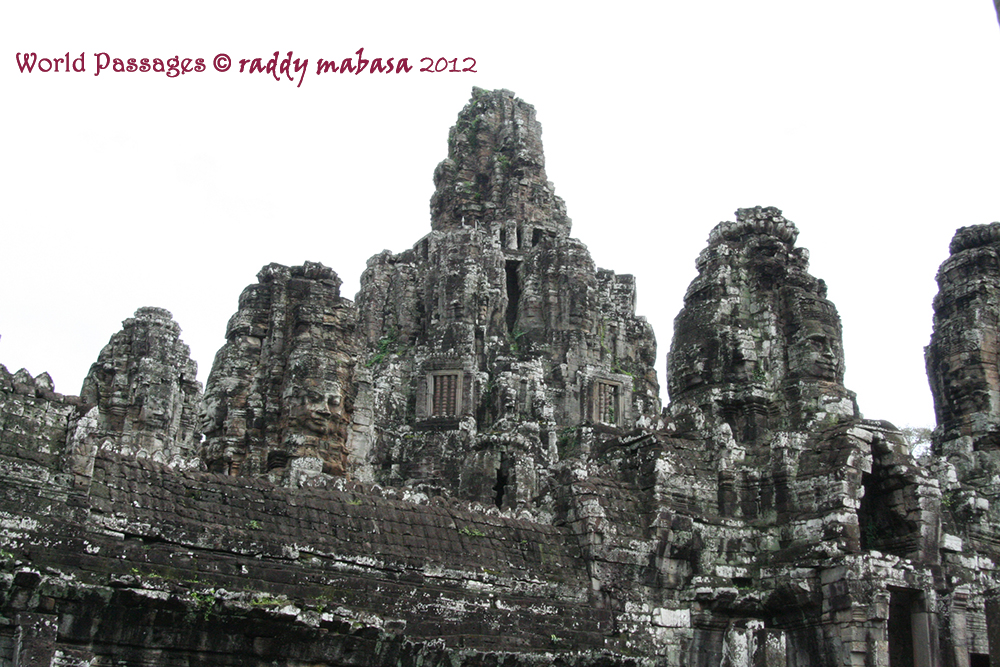
As you walk around the inner parts of the complex, you see so many serene smiling faces that seem to contemplate a content and happy life. There are in fact 216 of them all over The Bayon ("That" I remember). 


After getting our fill of the place, we felt it was time to fill our tummies and we made our way out of the area. This is what you will see as you turn around and take one last look...
 
 
Over a nice relaxed lunch, we talked about how little we know about our world and how much there was to learn. Sooner or later talk of the Khmer Rouge came up and how we knew next to nothing of the atrocities they committed all in the name of misguided nationalism.
 
Led by Pol Pot, the Khmer Rouge ruled from 1975 - 1979. During this reign of terror, they drove everyone out of the cities and tried to exterminate what they perceived as the intelligentsia. Khmer Rouge guerrillas carried out mass executions and killed professionals and educators. They killed someone for wearing glasses because in their twisted mind wearing glasses meant that a person was educated and he was the enemy of the state.
 
People died of starvation or disease, families were forced to separate, women were raped, and there was very little the population could do to fight back. We take our liberties for granted these days and stories like these make us appreciate our living conditions more. I've asked a few locals about this part of their history but most would rather not talk about it. Vana, our guide, said that it's not that they choose to ignore their past but that they would rather move on. These events happened less than 50 years ago and there are still people around who lived through this dark time in their history.
 
International studies estimate that between 1.4 to 2.2 million were killed in that period of less than 5 years. In that short time, roughly 20-25% of the population was exterminated for no rhyme or reason.
 
Sorry about sneaking in the sobering history lesson, but I have always believed that learning about a country isn't only about visiting the touristy places, shopping or lounging by the pool. I have always wanted to learn more about the history and culture of the country and the people I visit. This helps me to understand them better.
 
I am hoping that you will still join me for the last part of this series, There are still two very beautiful sights to see.

Monday, 1 October 2012

Stunning Siem Riep (Part 1) - Raffles D' Angkor

Angkor Wat.

Hearing those words spoken would often evoke thoughts of mysterious otherworldly bygone days. The truth is, unless you have actually gone and walked the ruins of this temple, you wouldn't know what to expect. Located in Siem Riep in the Northwestern part of Cambodia and reputedly "discovered" by the Frenchman Henri Mouhot, it is considered the largest Hindu Temple complex in the world.
 
Enough about that for now, first we need to get to Siem Riep. There are direct flights now from Manila but back then one route was via Singapore. 
 
The airport in Siem Riep is not one of those modern glass and steel structures. It's architecture had a very local feel and there were no air conditioned tubes extending out to the plane. When you disembark, the heat and humidity greets you in its embrace. Siem Riep isn't very large or modern. It is more like a quaint and familiar provincial town for tourists. A 15 minute car ride will usually get you to your hotel of choice. Our home for the next 5 days was the Raffles D'Angkor. The first thing you see are the Royal Gardens across the hotel. This is how it looks from our hotel room.
 
 
And this is one of their rooms.
 
 
Do you see the copse of trees on the right hand side of the first photo? Around 6 every evening, large bats would fly out of them and head out on opposite directions. We were told that this is when they would forage for food and they eventually return at sun up. This is part survival instinct on the part of the bats, for if they fly out in daylight, they will get shot and end up as someones meal. Check it out...
 
 
Service at the Raffles D'Angkor was superb! Everytime you enter the premises, you are greeted with a cold towel, everyone greets you a good morning on your way down to breakfast, the attention to detail is excellent. Every night they turn down your bed linens and they would leave a bunch of papers on the bed. I assumed it was just laundry service or room service breakfast. It was on our last night that I realized among them was a short story written by a noted author. Every night had a different sheet. I requested for copies to take home with me and I was gladly accommodated. It was upon reaching home that I found out that these stories were excerpts of novels written about Siem Reap.
 
Usually, check in is done at the front desk. Not here! They sit you down in a spacious lounge that is so colonial in decor and this is where they let you relax while they process your reservation and give you your room keys. This is also where we would hang out some evenings and listen to a friendly Filipino pianist named Carlos play the classics. I was referring to Sinatra and not Mozart.
 
 
Every night at 7, the hotel would also host a 30 minute event in the lobby. It could be anything from wine tasting, to learning about products made from palm trees, taste testing canapes. This was the set up for a lesson about decorating with lotus flowers and leaves.
 
 
As it was still light out when we arrived, I had a chance to take some photos of the gardens and pool of the hotel.


Every morning we would look forward to breakfast. Our favorite was the pancake, waffle and crepe station. There were untold possible combinations and variations. There was also an omelette and noodle soup station. 5 kinds of fresh juices and combination fruit and vegetable juices were also available aside from cereals, cold cuts, salads and hot dishes. This is where it all happens...
 
 
Other activities that are offered are the Apsara Dance and Dinner that showcases classic Khmer dishes as well as classical dances and period costumes (Not to mention the pretty dancers).


There is also a short cooking course that includes a visit to the local wet market.
 
 
I love the way they display the young corn.

 
Different varieties and sizes of cucumbers.

 
A monkey would go ape around all these bananas!

 
One thing this Raffles Hotel is known for is that they have oldest usable wooden elevator. It only goes up 3 floors, fits only 4 people and moves slowly, but it works!
 
 
With that we put an end to part 1. It would have been nice to say that all these photos were taken on that first day in Siem Riep. One neat tidy package. It isn't so. So, this first part just focused on the hotel and what it has to offer it's guests. Next up will be essays on what we felt were the 4 important temples nearby and going around the town as well as part of it's recent history. We can't avoid talking about the dark days under the Khmer Rouge. Please follow is as we update our stories.

Waterscapes

Looking at water can always be relaxing. Add to that the sound of waves and birds and a soft cool breeze...aaahhhh Thinking about it makes me want to pack and head to the nearest beach, lake or river.  Since that would entail a lot of effort I decided to just compile a set of photos that may tickle your fancy.
 
This first photo is a night time scene. This was taken at around 6:30 in the evening at the Maquinit Hot Springs in Busuanga (Coron). This particular spring is unusual in that the water is salty.
 
 
Let me paint you a picture...ok, not that one, another one, in your mind, smarty pants... Imagine the sound of crickets and a gentle salt air breeze, you are sitting in a pool filled with flowing hot water up to your chest. It's drizzling, and as you look up, the cool rain water softly pelts your face and neck. Mist hangs above the water line creating a sense of expectation, like a curtain opening before a show. And that is what you see in front of you, mangroves whose leaves catch and cascade raindrops in a rhythmic drip drop and the gently undulating waves of the sea. Sigh...You gotta experience this at least once...
 
Next are a few sea views from around the Philippines...
 
Bagac, Bataan
 
 
Coron Island
 
 
Panglao, Bohol
 
 
Boracay
 
 
Sabang Town, Puerto Princessa, Palawan


So far those last few images have been of calm seas. There are times though, that it's nice to see the forces of nature at work. Take this photo of waves crashing against an exposed reef just offshore. You can just imagine the pounding sound of water on corals as the froth explodes in a crescendo of bubbles.
 
 
Outside the Philippines, one particularly interesting location is Halong Bay in Vietnam. This body of water contains roughly 2,000 limestone islets and is a 3 hour ride from Hanoi. I plan to write more about Hanoi in a future post, but in the meantime here is a sneak preview.  In the waterline at the center of the photo you can just make out an opening where a boat can go through and into a large lagoon surrounded by limestone cliffs. It's quite impressive. 
 
 
Let me finish up with 2 photos of locations that are near water.
 
This is Hong Kong Harbour with Wan Chai in the background. Featured very prominently is the Convention Center whose roof is shaped like a turtles carapace.
 
 
Shanghai with the brightly lit Bund on the banks of the Huangpu River. There are dozens of River cruises available and they offer anything from buffet dinners to concerts on board.
 
 
Oh, If anyone out there would like to use any of these images for a desktop photo on your computer, just e-mail me...I'll share!